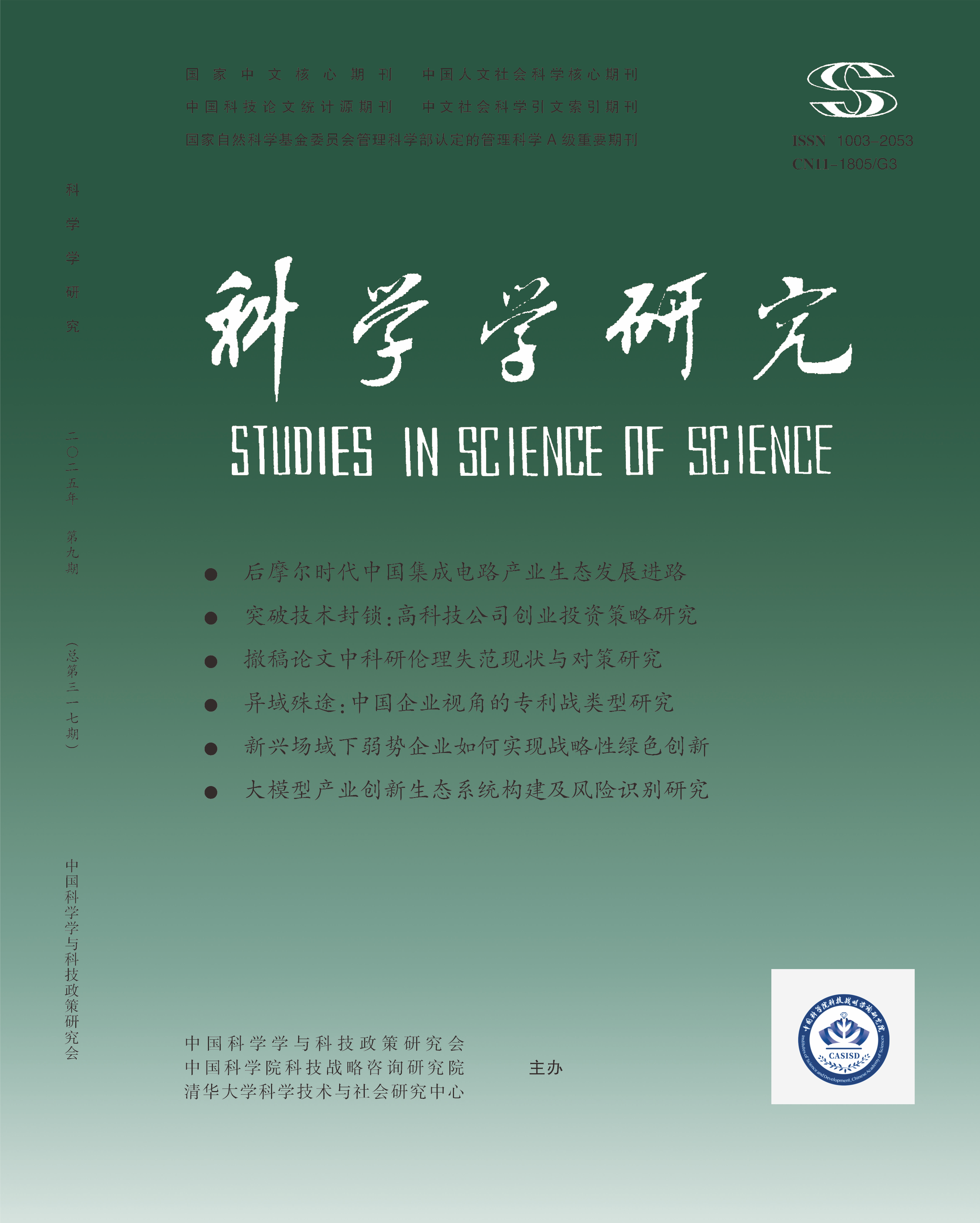
Development strategies for China’s integrated circuit industrial ecosystem in the Post-Moore Era
后摩尔时代中国集成电路产业生态发展进路
DOI:
https://doi.org/10.65967/siss.v43i10.110Keywords:
post-Moore era, integrated circuit industry, ecosystem strategy, China’s digital economy, new nationwide systemAbstract
The post-Moore era marks the period following the breakdown of “Moore's Law,” which predicted that microprocessor performance would double approximately every two years. In this era, integrated circuits are approaching the physical limits of material density and process technology, while energy consumption costs are rising significantly. The onset of the post-Moore era has led to three major technological shifts. First, in advanced silicon-based semiconductor manufacturing, the first-mover advantage of leading nations, regions, and companies is gradually eroding. Second, new competitive arenas are emerging in advanced packaging technologies and the development of alternative materials for silicon-based chips. Third, the rise of the RISC-V architecture is challenging the longstanding market dominance of Intel x86 and ARM architectures. The post-Moore era has also reshaped the competitive landscape, characterized by oligopolistic market structures and the increasing nationalization of key industry players. These developments offer new opportunities for China’s integrated circuit industry. In light of China’s burgeoning digital economy, which continuously creates new scenarios and markets, we propose that the Ecosystem strategy for the development of China's integrated circuit industry in the post-Moore era should encompass four types. First, mature ecosystem, which adheres to the singular technological path of More Moore, and the goal is to enhance the industry's autonomy and controllability, as well reducing the risk of being subjected to critical constraints. Second, scenario-driven ecosystem, which follows the integrated technological path of More than Moore and More Moore, and the aim is to leverage China's rich application scenarios to expand the boundaries of the integrated circuit industry ecosystem, while continuously promoting the industry's digital transformation and achieve autonomous control over the integrated circuit industry ecosystem from the end of key application scenarios. Third, future industry ecosystem, which integrates all three technological paths, with a key focus on breakthroughs in Beyond CMOS technology, and the objective is to capitalize on the advantages of a new nationwide system, to plan moderately ahead, and to seize the high ground in future international competition. Fourth, internationalized ecosystem, which emphasizes expanding China's diversified industrial ecosystem into the international market, and the purpose is to actively integrate into the global innovation ecosystem, further expand the scope of scenario-driven ecosystems, and enhance the resilience of the ecosystem. To address the challenges in the development of China's integrated circuit industry in the post-Moore era, it is essential to leverage the advantages of China's super-large scale market and its new nationwide system. First, in the domain of mature ecosystems, reconstructing the industrial chain, along with the support and guidance of industrial policies, can help build a second ecosystem that is autonomous, controllable, and compatible. Second, based on the combined technological approach of System-on-Chip (SoC) and System-in-Package (SiP), the rich application scenarios can be utilized to expand the boundaries of the industrial ecosystem. Simultaneously, by infiltrating through scenario applications, it is possible to gain dominance in these emerging industrial ecosystems. Third, proactively layout advantageous industrial ecosystems around future industries. Additionally, there should be innovation in the organizational models of industrial internet and the promotion of industry-level data element market construction, ensuring that various production relationships meet the development needs of key core technologies in future industries. Fourth, based on the characteristics of dominant countries and dominant enterprises in different segments of the industrial chain, China can adjust its strategies targetedly to actively integrate into the global innovation ecosystem and international industrial ecosystems.
Downloads
Published
Issue
Section
License
Copyright (c) 2025 Studies in Science of Science

This work is licensed under a Creative Commons Attribution-NonCommercial 4.0 International License.